
Lab Weekly — 07/29/2022
The meme-driven consumption of food and drink; New Floor 9 episode on the metaverse development; Plus, the latest news and must-know stats roundup

Want this newsletter in your inbox every Friday morning? Sign up for our mailing list here

Pink Sauce & Caviar Bumps: Decoding the Meme-Driven Gen Z Food Trends
And how food and beverage brands can react through distribution and marketing innovations
Outlook 2022: Southeast Asia POV
Four innovation trends shaping the future of media & technology in Southeast Asia

In case you missed it…
The Future of Entrepreneurship
In order to find a viable path to success in the increasingly chaotic environment, entrepreneurs and small business owners will need to embrace the disruptions and innovations that digital technology brings, and smart financial service and B2B brands will need to adapt their products and services to better support them.
Learnings from Netflix’s Recent Woes & Moves
For years, Netflix has been held up as the poster-child for the cord-cutting movement and the market leader in the streaming wars. Yet, recently it seems to have hit a snag after years of unbridled growth and global expansion. By examining the global streamer’s recent woes and moves,we aim to decode the shifting dynamics in the OTT space, and predict what may be coming next to the entertainment industry.

Episode 141: The Metaverse Mid-Year Check-In (Ft. Joshua Lowcock)
This week, we welcome back Joshua Lowcock, UM’s Global Chief Media Officer, for an in-depth discussion about all things metaverse with our SVP, head of strategy, Adam Simon. From where the metaverse currently sits in the hype cycle, to the competitive landscape of the platforms with “metaverse aspirations,” to understanding the metaverse as a operating system, Joshua and Adam talk through the various key aspects of this hot-button concept and, more importantly, what it means for brand marketers eager to enter the metaverse.
As always, you can find Adam on Twitter @adamjsimon, and Ryan on LinkedIn. Follow the Lab on Twitter @ipglab and on Medium for our latest insights.
Click here to listen and subscribe! If you enjoyed the episode, please consider giving us a five-star review on Apple Podcast. Thanks for listening!

The NFL Launches Its Own Streaming Service [The Verge]
The top news story of the week belongs to NFL+, a direct-to-consumer streaming service that the NFL launched this week to reach a wider audience of younger fans who have cut the cord and no longer have access to live sports. Interestingly, unlike the other streaming services, NFL+ will be strictly mobile-only — it will carry live, local, and primetime regular and postseason games, but only available on phones and tablets, and not on connected TVs of any kind. The NFL’s existing licensing deals with other streamers further complicate the league’s attempt to digitize its content offerings.
Economically, the reasoning behind this seemingly backward restriction on non-mobile streaming makes sense, considering that the NFL has always needed to balance between the growing imperative to reach more streaming audiences and avoiding cannibalizing its lucrative TV contracts. However, this restriction placed on NFL+ does significantly impair its value proposition as it goes against the basic viewer behavior and preferences. When consumers are on their mobile devices, they are far more likely to consume sports content in mobile-native formats, such as score notifications and highlight clips on social media; Few people are looking to stream a whole NFL game on their mobile devices if they have access to bigger, better screens.
On a broader scale, sports content, especially premium live sports content, remains the lynchpin that holds many to their pay TV bundles in 2022. However, regional sports networks and big tech companies with cash to burn are both eyeing the soon-to-expire licensing deals that the major leagues have with major networks. Latest report indicates that Disney, Apple and Amazon are all in the running to become the new broadcast rights owner of the NFL’s out-of-market Sunday Ticket package, while regional sports networks like NESN and Sinclair-owned Bally Sports are looking to the opportunities presented by streaming as cord-cutting rate continues to grow. Sports broadcasting is about to enter a messy, fragmented streaming age where content from one major sports league may be scattered over a few streaming services and networks. From this angle, this mobile-only ESPN+ service can be seen as both a stopgap and a preemptive move to lay the groundwork for an eventual digital re-bundling of sports content.
Related: Regional sports networks plot streaming future without pay TV bundle [THR]; Why big tech is making a big play for live sports [NYT]; YouTube is in the running for NFL Sunday Ticket [ARS Technica]
SoulCycle Exchanges Used Peloton Bikes For In-Person Classes [Business Insider]
While some may consider this a “trolling” campaign from Soulcycle to kick Peloton while it’s down, I do think this campaign also speaks to a larger trend of people growing to regret some of the impulse purchases they made during the worst of the intermittent periods of lockdowns and outbreaks over the last two years. Now that people in most parts of the world are starting to “return to normal” (a debatable concept in itself — but that’s a topic for another time), it’s understandable that some consumers are looking back on their pandemic purchases and reconsidering their long-term usefulness. Peloton bikes and other home gym equipment are certainly among the categories that received a major pandemic boost but are now dealing with a halted growth outlook. Naturally, some in-person fitness service providers are now capitalizing on this trend and trying to lure people back into gyms and in-person sessions.
A similar dynamic is playing out in other verticals as well. For instance, Shopify recently laid off 10% of its workforce while acknowledging that one side effect of the “pandemic boost” in ecommerce adoption is that it not so much accelerated the growth rate, but rather “binged” the future growth while retaining the same growth rate in the long run as people return to normal (see chart from Shopify’s announcement post of the layoff below).
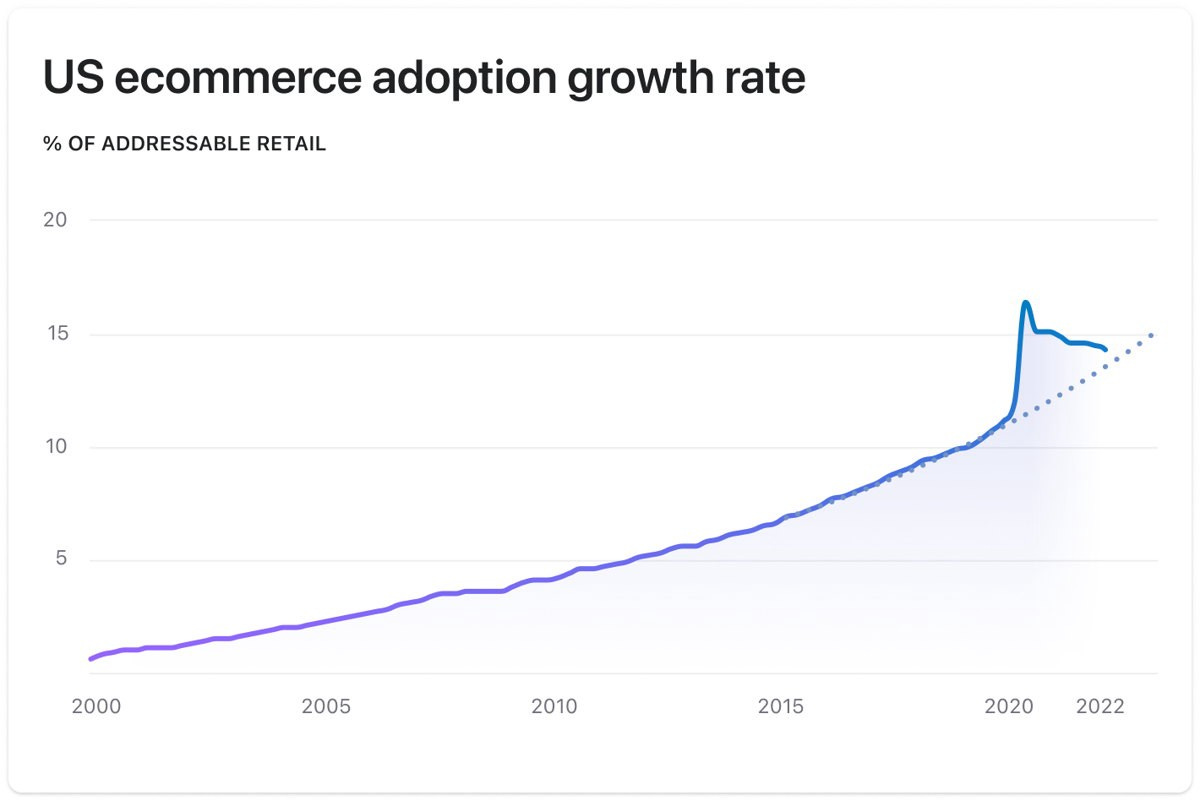
This “binge” dynamic could “explain a lot of the weirdness in macro, technology, and retail inventories,” as Derek Thompson, a staff writer for The Atlantic, pointed out in a tweet. Some of the pandemic-era accelerations have either decelerated or even backslid to pre-Covid growth trajectory, and the brands that still held onto their in-person businesses see the opportunity to counter-strike. The question now, however, is how long it will take for this trend to subside as consumers start to fully weigh the pros and cons of the digital offerings born out of the pandemic against the conventional ones. If the continued march towards hybrid work is any indication, brands should learn to balance the two and properly deal with the “hangover” effects of this “binge” dynamic
Related: Peloton to outsource all manufacturing as part of its turnaround efforts [CNBC]; From Pelotons to pets, the Covid buys people wish they’d left on the shelves [Vox]
Instagram To Roll Back Changes After Users Protest [The Verge]
Instagram is going through a bit of an identity crisis. A quick succession of new features and tests that increasingly make the app look like TikTok has annoyed even the app’s most loyal users, including Kim Kardashian and Kylie Jenner, who recently aired their grievances with Instagram’s latest changes by reposting a Story pleading for the app to reverse course.
Unsurprisingly, their celebrity protest kicked off a media narrative this week of many Instagram users longing for the good old days of Instagram as a photo sharing app, and decrying its recent changes to emphasize Reels and shopping features. But as Taylor Lorenz pointed out in her newsletter, we don’t actually want to go back to the old, chronological Instagram feed that focuses on photos with pretty filters. The attention economy has significantly shifted in the past ten years since Instagram was bought by Facebook, and changing norms around online sharing, communication, privacy, and engaging content format have made it impossible for Instagram, or any other social platform, to stay the same without losing users.
While there is certainly an argument to be made about Instagram being too over-stuffed with features that fulfill entirely different consumer needs, its leadership team also knows that it can’t just stay the same and watch TikTok eat its lunch. Head of Instagram Adam Mosseri certainly knows this. In a video response he posted on Instagram on Tuesday, assuring the disgruntled users that these TikTok-esque changes to the app are only in testing, while ultimately reaffirming that Instagram will have to evolve to keep up with the times. However, he seems to have changed his tune by Wednesday. In an interview with Casey Newton, Mosseri revealed that Instagram plans to walk back some recent changes to the product in response to a week of mounting criticism.
As Instagram continues to sort out what type of platform it wants to be, we may expect to see more of these types of back-and-forth. Ultimately, if Instagram does decide to lean into the “media” aspect of “social media” and compete with TikTok on the strength of entertainment value, then perhaps it’d create a bigger opening for the emerging apps that focus on connecting users with their family and friends, such as BeReal, to take over the “social” part of social media.
Related: You don’t want the old Instagram [Taylor Lorenz’s Newsletter]; Facebook doubles down on algorithms in the main feed [The Verge]

More than 39,000 TikTok accounts now have at least 1 million followers — about 6,200 more than on YouTube, and nearly 16,000 more than on Instagram, The Information reports. With so many influencers over the 1 million mark, the competition for sponsorship deals is growing more competitive.
YouTube brought in $7.34 billion in advertising revenue during the second quarter, parent company Alphabet reported in its quarterly earnings on Tuesday. The Q2 revenue was up only 4% on the video platform’s second quarter revenue of just over $7 billion in the same period of 2021
Streaming made up one-third of U.S. television consumption last month, per Nielsen — the highest percentage since the media measurement firm began its monthly report in June 2021. Time spent streaming has jumped 23.5% in the past year — a sign that consumers are still migrating to digital TV in droves.