
Lab Weekly - 02/02/2024
Apple vs. the Gaming Industry; Plus, the latest news about Arc Search, TikTok, and more

Want this newsletter in your inbox every week? Sign up for our mailing list here

What Apple’s Recent App Store Policy Changes Mean for the Gaming Industry
Last week, Apple announced that it is changing its app review policy for in-app experiences, especially pertaining to streaming games. Effective immediately, apps containing games, “mini-apps,” and chatbots, can now be submitted as a single app for review. In theory, this change marks a huge shift for those in the cloud gaming business, which could then have knock-on effects for advertisers as well. In reality, however, things are much more complicated.

In case you missed it…
Outlook 2024: Downstream Effects
Welcome to the IPG Media Lab’s 2024 Outlook. Each year, we round up the ideas that excite us for the next few years: new technologies, market forces, and shifts in consumer behavior that are changing the media landscape. This year, we are particularly interested in how the second-order effects of the pandemic will play out over the rest of the decade.
As always, the entire Lab team was in Vegas in person, pounding the show floors to bring you the noteworthy exhibitors and must-see innovations. Here are the top five trends we spotted at CES 2024.

Episode 153: CES 2024 Recap
The Lab team assembles to recap the key trends we saw at CES 2024, from transparent TVs to surprising AI integrations. Listen now!

Arc Search Combines Browser, Search Engine, And AI Into One App [The Verge]
Arc, a browser app created by The Browser Company, is ushering in an interesting experimentation with AI-powered search with a new browser app. Unlike traditional browsers that open with tabs, Arc Search starts with a search field, offering detailed summaries from various sources instead of plain search results. So instead of offering up a selection of links to existing web pages that may contain answers to your question, Arc will essentially create a new page specifically for your inquiry. The app archives tabs after 24 hours to avoid clutter, offers a reader mode for cleaner reading, and blocks trackers by default.
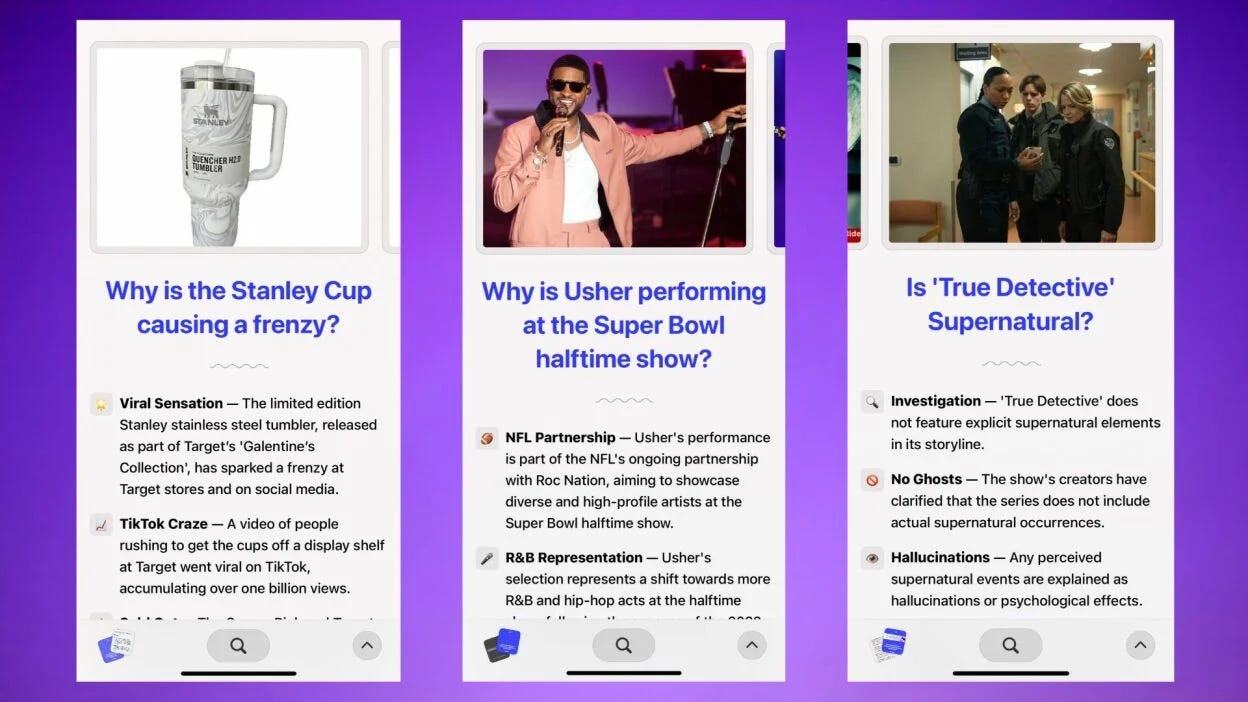
At the moment, Arc Search is too simplistic and lacks some basic features like bookmarking, or a "read later" option to be fairly compared to full-featured browsers. The Browser Company knows that and says it plans to integrate more features soon. That said, Arc's approach, focusing on AI to synthesize and summarize information from across the web, suggests a future where search engines might prioritize delivering more contextually rich, concise, and immediately useful information directly within the search interface. If this approach takes off, then the rules of SEO and search advertising would have to be rewritten.
Related: Google introduces new Circle to Search feature on Android [TechCrunch]; Yelp's new AI features include auto-generated business summaries, among other updates [Engadget]; Amazon debuts ‘Rufus,’ an AI shopping assistant in its mobile app [TechCrunch]
TikTok Trials Feature To Make All Video Posts Shoppable [Bloomberg]
In another bid to diversify its revenue streams, TikTok has started testing a feature that automatically turns all the short videos on its platform shoppable. Leveraging computer vision and visual search technologies, this new feature automatically identifies objects in a video and prompts viewers to “find similar items on TikTok Shop.”
Previously, this feature was only available to approved influencers and brands to help them monetize their videos. By potentially turning on this feature by default, TikTok would obviously broaden the amount of shoppable videos on its platform, which could theoretically lead to increased sales for TikTok Shop. However, not all videos are suitable to be turned into a soft product placement ad. In addition, Bloomberg’s reporter found that the items being surfaced by the feature are not always a perfect match to the video content, which could further downgrade the user experience.
Combined with the recent report on TikTok increasingly mimicking YouTube by embracing horizontal videos and longer-form content, it would seem that TikTok is undergoing a minor case of identity crisis. While it’s understandable why TikTok would test this shoppable feature as a shortcut to boost its social commerce initiatives, it might not be the best shortcut to take.
Related: TikTok Plans Los Angeles Live Studios to Boost Shopping Sales [The Information]; Peloton Partners with TikTok for Workout Content Hub [WSJ]
Prime Video Now Charges Extra for Ad-Free Streaming [WSJ]
Streaming services, once celebrated for ad-free viewing compared to cable TV, have been adding commercials to their services in a bid for better profitability. Now, Prime Video, one of the last holdouts on ad-supported plans (give or take a Freevee) has turned its previously ad-free base tier into an ad-supported one, with an ad-free option costing an extra $2.99 per month. This change, following the introduction of ad-supported base tiers at Netflix, Max, and Disney+, means that Apple TV+ remains as the only major streaming service that does not have an ad-supported tier.
With a reasonable ad load, streaming services can maintain a balance between generating more revenue and preserving the quality of the viewing experience. However, the challenge lies in defining what constitutes a 'reasonable' amount of advertising without alienating subscribers accustomed to ad-free content. As streaming services navigate this transition, they must carefully consider the impact on subscriber satisfaction and retention.
Related: Disney+, Hulu and ESPN+ will start cracking down on password sharing [CNN Business]; Netflix expects to fully phase out cheapest no-ads plan [Variety]

When it comes to social apps, Americans are sticking with what they know. Per the latest data from Pew Research Center, 83% of U.S. adults use YouTube; 68% use Facebook; 47% use Instagram; 33% use TikTok, 29% use WhatsApp, 30% use LinkedIn, 27% use Snapchat, and 22% use X and Reddit.
However, TikTok is certainly the fastest growing social app. One-third of respondents to the survey, which was conducted among 5,733 adults between May and September last year, reported having used TikTok, up from 21% in 2021.
62% of 18- to 29-year-olds say they use TikTok, much higher than the share among adults ages 65 years and older (10%).
AI poisoning tool Nightshade, created by computer science researchers at the University of Chicago, has received 250,000 downloads in the first five days of its release, VentureBeat reports. The tool aims to disrupt AI models scraping and training on artworks without consent by altering images on a pixel level.
Apple says its credit card offer Apple Card now has 12 million U.S. users, and over 1 million users are sharing their card with family members via Apple Card Family. Moreover, Apple Card users earned a total $1 billion in Daily Cash rewards in 2023.

If you find our insights valuable and would like to have a deeper conversation on technology and media innovations, or need to sound smarter in a client meeting or a pitch, please feel free to reach out to Chelsea Freitas, our VP of Strategy, at chelsea@ipglab.com.
If you liked this edition of Lab Weekly by IPG Media Lab, why not share it?